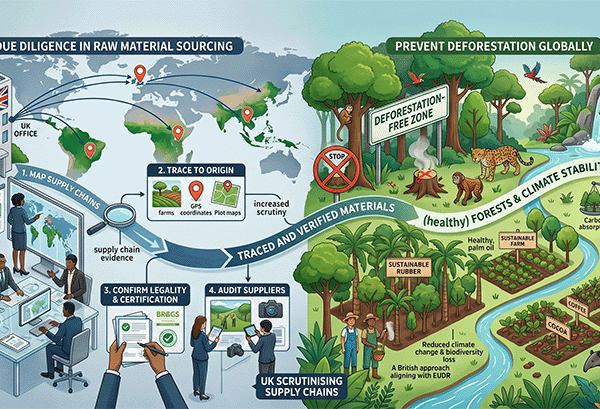
The UK Government will introduce new due diligence requirements for businesses placing forest-risk commodities on the Great Britain market. Organisations will be required to demonstrate that relevant supply chains are not linked to illegal deforestation.
The announcement was confirmed on 23 June 2026 during London Climate Action Week. The measures will be introduced using powers under the Environment Act 2021, alongside a strengthened UK Timber Regulation framework. A formal consultation on the detailed requirements is expected later in 2026.
Key dates
- 23 June 2026 – Government confirms intent to introduce Great Britain deforestation due diligence rules
- Before 30 December 2026 – UK-wide consultation with industry, civil society and international stakeholders
- 30 December 2026 – EU Deforestation Regulation (EUDR) begins phased application in Northern Ireland
- 2027 – Expected introduction of Great Britain legislation
What the rules are expected to cover
Businesses trading in forest-risk commodities will be required to carry out due diligence to confirm that products are not linked to illegal deforestation.
Government references include cocoa, soy, palm oil and rubber, with coffee widely expected to be included given alignment with the EU Deforestation Regulation (EUDR). The final scope will be confirmed through consultation and secondary legislation.
These commodities are embedded across food, beverage and consumer product supply chains, including chocolate, cooking oils, processed foods, cosmetics and personal care products.
Alignment with EU requirements
The Department for Environment, Food and Rural Affairs (Defra) has indicated that the Great Britain framework is intended to align closely with the EU approach rather than diverge significantly.
The consultation is expected to consider mirroring key elements of the EUDR, including commodity scope and due diligence information requirements, to reduce duplication for businesses operating across both markets.
Enforcement and compliance expectations
While the policy direction is confirmed, enforcement mechanisms and verification processes are not yet defined.
However, businesses should expect increased scrutiny of supply chain evidence, particularly where claims relate to deforestation-free sourcing. Organisations with robust, audited traceability systems are likely to be better positioned to demonstrate compliance.
Geographic scope
The proposed rules will apply to Great Britain (England, Scotland and Wales).
Northern Ireland remains aligned with the EU system due to continued access to the EU Single Market, meaning the EUDR will apply there in phases from 30 December 2026.
Policy context and drivers
The Government cites the UK’s global supply chain footprint as a key driver for the policy.
Approximately 90% of global deforestation is linked to agricultural expansion, often associated with traded commodities. In 2023, UK consumption of forest-risk commodities was estimated to be linked to around 29,000 hectares of deforestation globally and approximately 9.4 million tonnes of associated carbon emissions.
Nature Minister Mary Creagh stated that addressing deforestation is one of the most effective ways to tackle climate change and biodiversity loss, noting that the UK is “leading by example and scrutinising our own supply chains”.
Industry response
Retail and environmental stakeholders have broadly welcomed the announcement.
The British Retail Consortium has previously supported stronger regulation, highlighting the limitations of voluntary approaches. Environmental organisations, including WWF, have also emphasised the importance of robust supply chain controls in addressing deforestation risk.
Some campaign groups have raised concerns that focusing only on illegal deforestation may not fully address global forest loss, as legality varies by jurisdiction. The Government has indicated that the policy direction may evolve over time towards broader deforestation-free standards.
What businesses should do now
Although the requirements are not yet law, the expected direction is clear. Businesses handling forest-risk commodities should begin preparing supply chain data and documentation now.
Recommended actions include:
- Mapping supply chains for coffee, cocoa, soy, palm oil and rubber
- Identifying country and plot-level origin data where available
- Reviewing legality documentation in source countries
- Strengthening supplier traceability systems
The ability to demonstrate end-to-end traceability will be central to future compliance expectations.
How certification supports readiness
Food safety certification systems such as BRCGS Food Safety already require structured supplier approval, traceability and documented supply chain controls. While these systems do not confirm deforestation-free status, they provide a strong foundation for the type of data and governance expected under upcoming regulations.
About PJRFSL
Perry Johnson Registrations Food Safety, Ltd. (PJRFSL) is an accredited certification body providing certification services to GFSI-recognised standards, including BRCGS Food Safety and SQF.